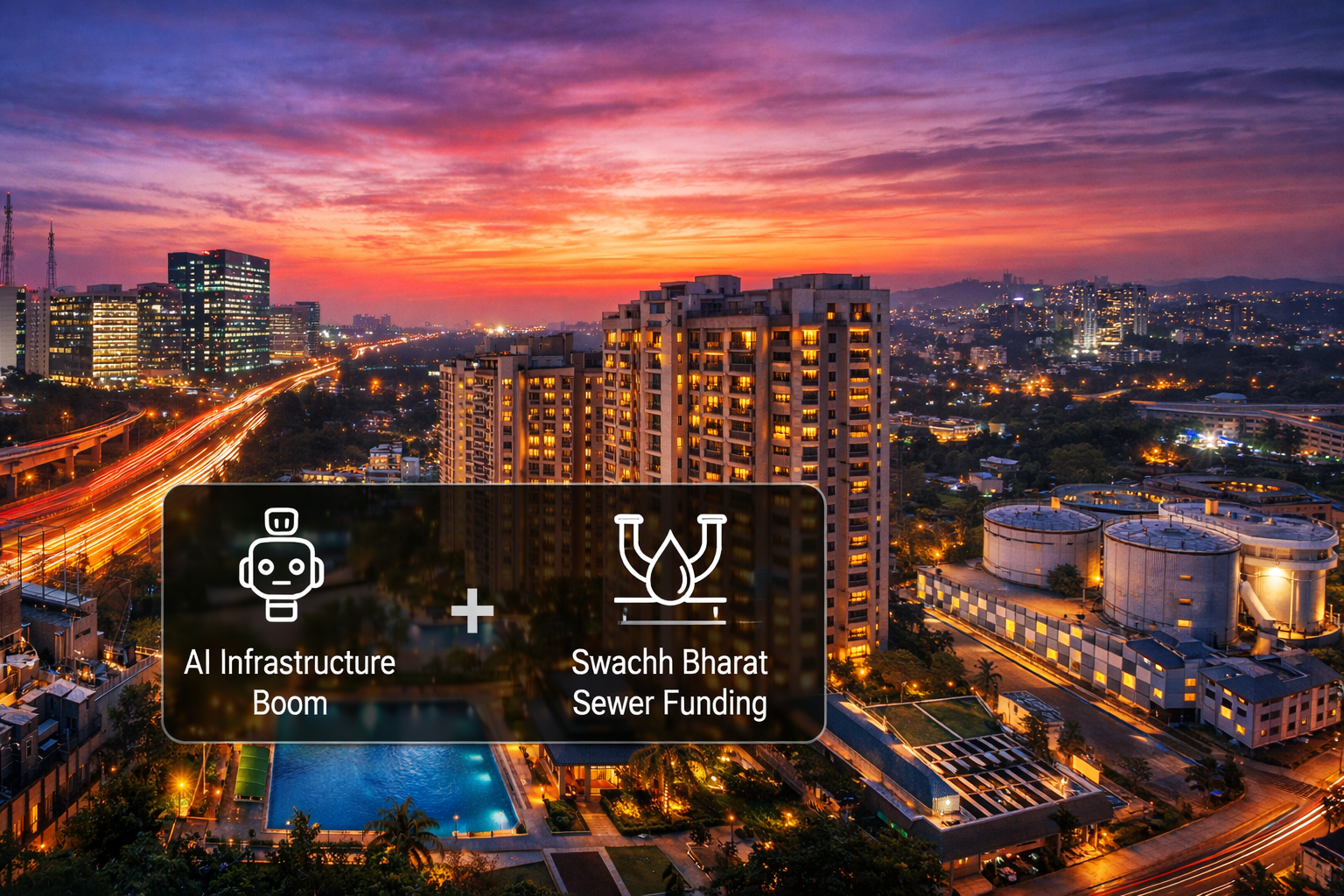
Two Macro Signals Are Converging on Hinjewadi — and Residential Pricing Hasn't Fully Caught Up
Two unrelated announcements made in the same week have a direct, compounding implication for Pune's Hinjewadi–Wakad residential corridor. RMZ Corp's $35 billion data centre and AI infrastructure commitment signals sustained tech-sector employment growth. Simultaneously, Maharashtra's allocation of ₹972 crore under the Swachh Bharat Mission 2.0 for sewage infrastructure projects in Pune and Nashik signals a long-overdue civic infrastructure upgrade that has historically suppressed pricing in Pune's western suburban belt.
Taken together, these are the conditions under which residential micro-markets reprice.
Employment Anchor: Why Hinjewadi Is the Right Address
Hinjewadi IT Park — across its three phases — houses over 700 companies and employs approximately 2.5 lakh professionals. It is Pune's dominant tech employment node, and it is precisely the geography that attracts data centre and AI infrastructure capex: established fibre connectivity, available land in adjacent zones (Marunji, Maan), and a deep engineering talent pool.
RMZ already operates commercial assets in Pune's western corridor. Any expansion of data centre or hyperscale infrastructure in this belt adds employment density — the primary driver of residential demand within a 10 km radius.
Current residential pricing in Hinjewadi Phase I and Wakad ranges from ₹8,200–₹11,800 per sq ft for premium mid-rise and high-rise projects. Marunji and Maan — emerging nodes 4–6 km further west — are currently transacting at ₹6,400–₹8,000 per sq ft, representing the entry-point opportunity for buyers with a 5–8 year horizon.
The Civic Infrastructure Dividend
Pune's ₹972 crore sewage infrastructure allocation under SBM 2.0 addresses one of the most persistent drags on western Pune residential values: inadequate stormwater and sewage handling that has historically created seasonal liveability concerns in rapidly-developed nodes like Hinjewadi, Baner, and Balewadi.
Markets with documented civic infrastructure gaps trade at a 7–12% discount relative to their employment-access-adjusted fair value — a discount that compresses as projects are commissioned. With a ₹972 crore programme now funded and contracted (Enviro Infra Engineers, awarded the project), this discount has a timeline to close.
For investors, this is a straightforward arbitrage: buy into the civic discount, hold through commissioning, exit into a re-rated market.
Rental Yield and Absorption Data
Pune's overall residential market absorbed approximately 13,200 units in Q1 2025 (Anarok estimates), with the western corridor (Hinjewadi, Wakad, Baner, Balewadi) contributing around 28% of volume. Gross rental yields in Wakad and Hinjewadi for a 2BHK unit (₹75L–₹1.1Cr) currently range from 3.6–4.2%, with monthly rentals of ₹24,000–₹38,000 depending on project quality and proximity to the IT park gate.
This yield band is marginally ahead of Bengaluru's Whitefield, reflecting Pune's lower entry price point relative to employment density.
Key Watchpoints for Buyers
- MahaRERA project pipeline for Marunji and Maan: three large-format township projects are expected to file in H2 2025, which will set a new price discovery benchmark for the emerging western belt
- Hinjewadi Metro (Line 3) civil progress — current target commissioning is 2027–28; projects within 500m of proposed stations are already carrying a ₹500–₹800 per sq ft forward premium
- SBM 2.0 project milestones: commissioning of sewage infrastructure in the Hinjewadi catchment zone is the single most trackable catalyst for discount compression
Pune's Hinjewadi–Wakad corridor is not a speculative call. It is a structural demand story — employment-anchored, infrastructure-upgraded, and currently priced below its fundamental trajectory.
Data sources: Anarok Q1 2025, MahaRERA, JLL Pune Residential Report Q4 2024, Maharashtra Infrastructure Pipeline.