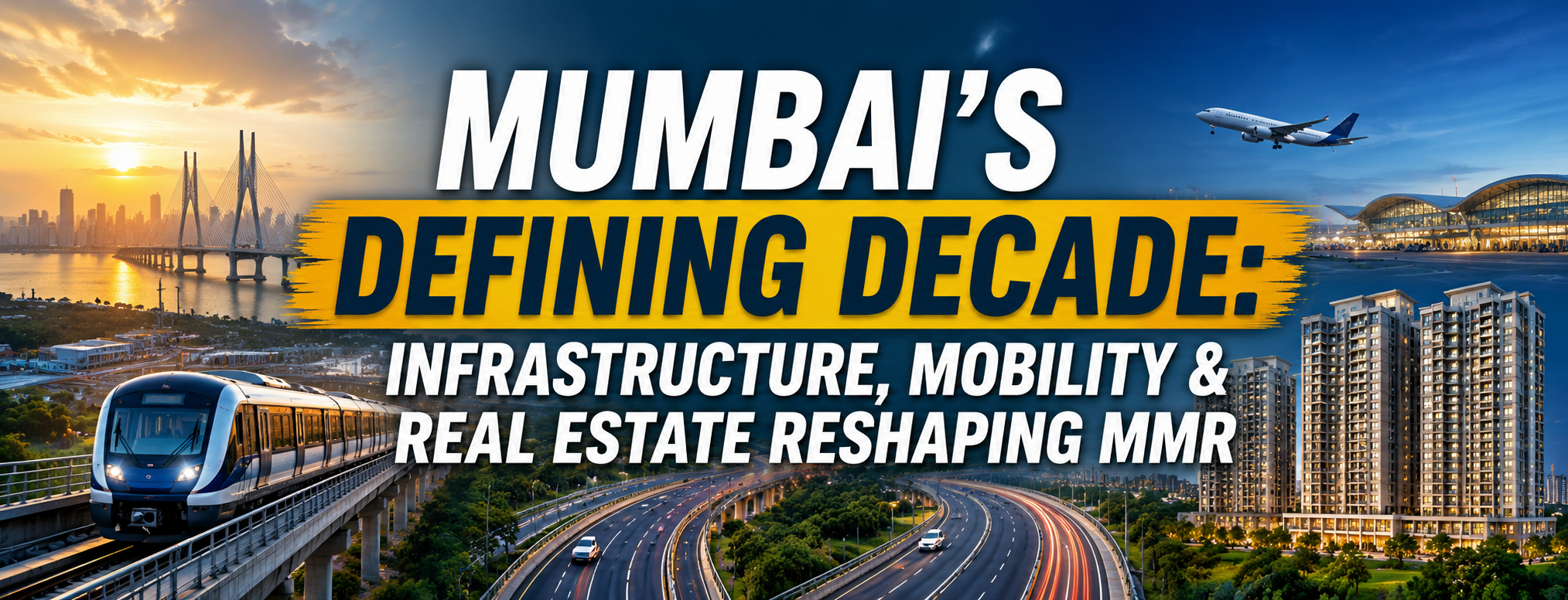
Mumbai Metropolitan Region is entering a transformative phase where infrastructure investment, mobility upgrades, and real estate expansion are becoming deeply interconnected. Projects such as the Metro network expansion, Mumbai Trans Harbour Link, and Navi Mumbai International Airport are not only reducing travel times but also redefining the geography of growth across the region.
Urban Mobility Is Redrawing Mumbai's Real Estate Map
Mumbai has historically faced a structural imbalance between employment concentration and housing affordability. Commercial activity remained concentrated in core business districts while affordable housing opportunities moved farther toward peripheral locations. This created long commute times, rising congestion, and uneven urban expansion.
Today, that equation is changing rapidly.
Mega infrastructure projects across the Mumbai Metropolitan Region are creating new mobility corridors that are expanding the practical boundaries of the city. The Metro network expansion, Atal Setu connectivity, Navi Mumbai International Airport, and upgraded highway systems are collectively reshaping how residents and investors evaluate real estate opportunities. [1] [8]
What was once considered "too far" is increasingly becoming accessible within practical commuting timeframes.
This shift is especially visible in emerging micro-markets such as Panvel, Ulwe, and Dronagiri, where infrastructure-led demand is driving both residential absorption and investor activity. [2] [3]
The Navi Mumbai Airport Effect
The Navi Mumbai International Airport is emerging as one of the biggest catalysts for regional transformation.
Historically, airport-led urbanization has reshaped real estate demand patterns across global cities. In Mumbai's case, the airport is expected to create a new economic gravity zone around Navi Mumbai, improving logistics, commercial development, hospitality activity, and residential demand.
Several reports already indicate accelerated property appreciation in airport-linked corridors. Some market observers estimate property prices in select nodes such as Ulwe and Dronagiri have already witnessed substantial appreciation due to future connectivity expectations. [3] [7]
Infrastructure optimism is also attracting institutional attention toward mixed-use developments, warehousing ecosystems, and transit-oriented real estate.
The Affordability Challenge
However, infrastructure growth alone does not automatically create inclusive urban development.
One of the biggest concerns emerging from this infrastructure cycle is affordability erosion.
As connectivity improves, land prices rise sharply around newly connected corridors. This is already becoming visible across several Navi Mumbai micro-markets where speculative land appreciation is beginning to outpace income growth.
The risk is clear: middle-income homebuyers may gradually get priced out of the very markets that were initially considered affordable alternatives to central Mumbai.
Industry experts increasingly argue that infrastructure expansion must be synchronized with land-use reforms, higher FSI efficiency, rental housing strategies, and affordable housing incentives. Without policy alignment, infrastructure benefits may disproportionately favor speculative capital rather than end-user housing demand.
What Investors Should Watch
For investors, this cycle presents both opportunity and caution.
Micro-markets linked to mobility infrastructure often experience strong early appreciation, but long-term sustainability depends on employment generation, social infrastructure, and balanced urban planning.
The key question is no longer whether infrastructure creates demand.
The real question is whether cities can maintain affordability while scaling infrastructure at speed.
Mumbai's "defining decade" may ultimately be judged not only by the scale of infrastructure delivered, but by whether the city succeeds in creating accessible, inclusive, and economically sustainable urban growth.