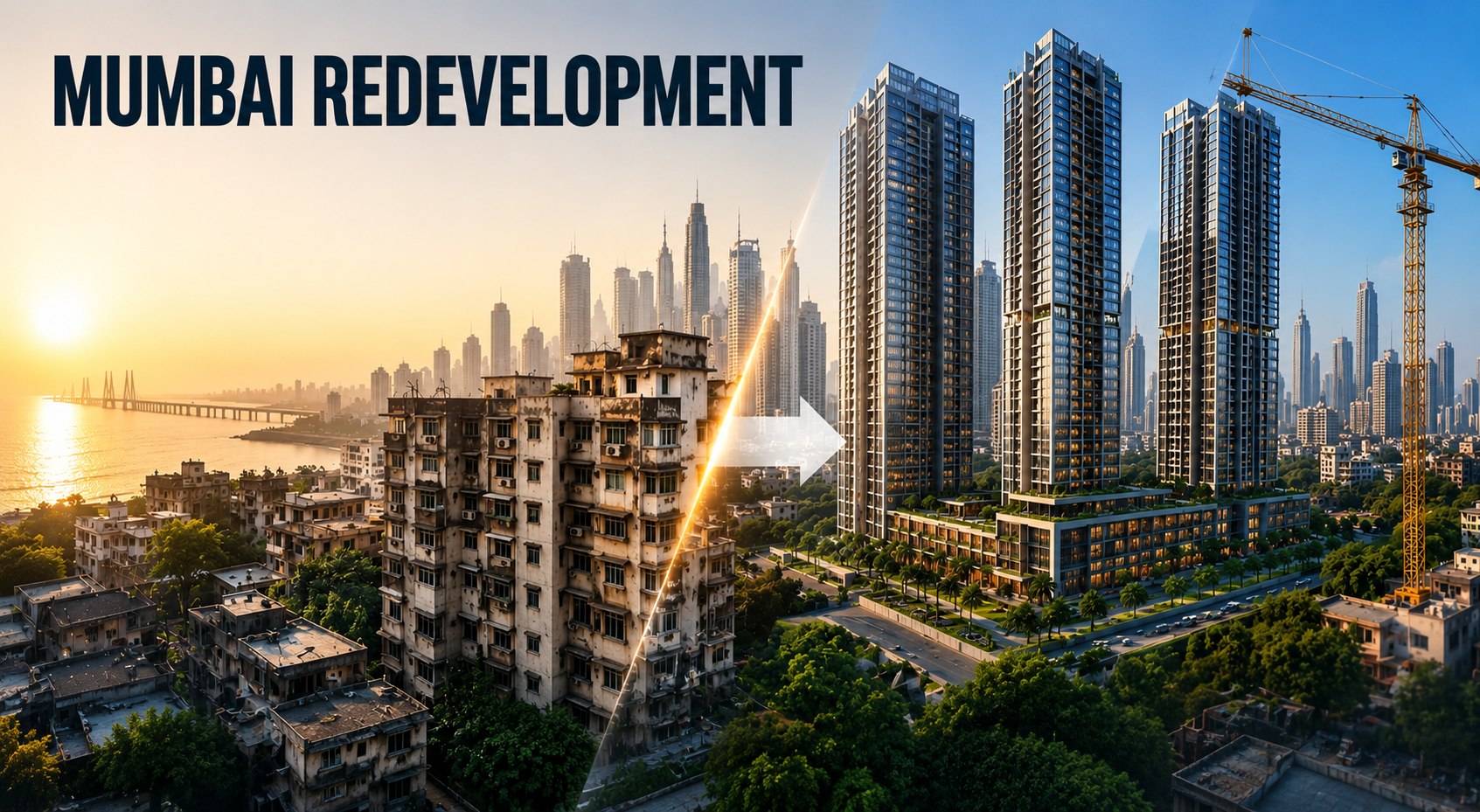
Mumbai's residential real estate market is no longer expanding outward. It is rebuilding upward.
Within the Municipal Corporation of Greater Mumbai (MCGM) region, redevelopment now accounts for nearly 60%–65% of all ongoing residential development and future inventory pipeline. Fresh greenfield development has shrunk to roughly 35%–40% of total supply.
This structural shift is transforming the city's housing economics, project pipeline, pricing dynamics, and long-term urban growth model.
Why Redevelopment Now Dominates Mumbai
Mumbai is a geographically constrained island city where more than 70% of land is already built up. In most core city locations, large raw land parcels have effectively disappeared.
As a result, the city has transitioned from a traditional horizontal expansion model into a vertical rebuilding model.
Instead of creating new housing supply through fresh land acquisition, developers are increasingly unlocking value by redeveloping:
- Old cooperative housing societies
- Slum clusters
- Cessed buildings
- Defunct industrial land parcels
- Mill lands and aging residential stock
This transformation has been accelerated by policy incentives under DCPR 2034, which allows developers to unlock higher FSI (Floor Space Index) through redevelopment-led projects.
Mumbai Real Estate Market Break-Up
Redevelopment Supply (60%–65%)
Redevelopment has become the dominant source of new housing supply across Mumbai city.
Key drivers include:
- DCPR 2034 incentives
- FSI premiums
- Aging housing stock
- Infrastructure-led appreciation
- Limited availability of fresh land
Most new launches across core Mumbai now originate from redevelopment transactions rather than greenfield construction.
Fresh / Greenfield Development (35%–40%)
Fresh development is now largely restricted to:
- Peripheral MMR locations
- Institutional land parcels
- Industrial-to-residential land conversions
- Large township developments
Most large-scale greenfield activity has shifted outside the island city toward Navi Mumbai, Thane, Panvel, and extended suburban corridors.
Internal Break-Up Of Mumbai's Redevelopment Market
The redevelopment segment itself can be divided into two major categories.
1. Slum Rehabilitation Authority (SRA) Projects
~50% Of Total City Development
SRA-led projects form the largest share of active construction activity within Mumbai's urban core.
Under this model:
- Developers rehabilitate slum residents free of cost
- Rehabilitation units are provided on-site
- Developers monetize the "free-sale component" through premium high-rise residential towers
This model has become one of the primary mechanisms through which Mumbai continues to generate new residential inventory despite severe land scarcity.
2. Private Housing Society Redevelopment
~12%–15% Of Total City Development
This is currently the fastest-growing redevelopment segment in Mumbai.
According to market data:
- Over 1,094 development agreements (DAs) have already been signed by cooperative housing societies
- Redevelopment activity in this segment has grown approximately 16% YoY
- More than 1.6 lakh aging housing societies are considered eligible for redevelopment over the long term
This represents a multi-billion-dollar redevelopment pipeline that could reshape Mumbai's housing landscape over the next decade.
Regional Micro-Market Break-Up
Redevelopment intensity varies sharply across different parts of Mumbai.
South & South-Central Mumbai
Redevelopment Share: 90%–95%
Key Markets: Worli, Mahalaxmi, Parel, Dadar
Characteristics:
- Virtually zero raw land availability
- Luxury redevelopment dominates future supply
- Most new launches emerge from cessed building or old property renewals
Western Suburbs
Redevelopment Share: 80%–85%
Key Markets: Bandra, Andheri, Borivali
Characteristics:
- Epicenter of housing society redevelopment
- Significant pipeline of replacement housing stock
- Strong premium residential demand
More than 60,000 apartments are expected to emerge from redevelopment-led supply in this region.
Eastern Suburbs
Redevelopment Share: 65%–70%
Key Markets: Ghatkopar, Chembur, Vikhroli
Characteristics:
- Combination of middle-class society redevelopment
- Industrial land conversion opportunities
- Growing infrastructure connectivity
Peripheral MMR
Redevelopment Share: 15%–20%
Key Markets: Navi Mumbai, Extended Thane, Panvel
Characteristics:
- Large-scale greenfield land still available
- Township-led growth model
- Major infrastructure-driven expansion corridors
This region represents the inverse of the island city, where fresh development still dominates.
Impact On Pricing & New Inventory
Redevelopment-led housing supply has fundamentally changed Mumbai's pricing structure.
Newly launched redevelopment projects now command substantial premiums over surrounding resale inventory.
According to market reports:
- Primary redevelopment inventory carries a 23%–46% premium over older resale housing within the same micro-market
This premium is driven by:
- Modern amenities
- Better layouts
- Higher tower efficiencies
- Improved infrastructure
- Brand-new inventory within established neighbourhoods
As redevelopment accelerates, Mumbai's future housing market is increasingly becoming a premium replacement cycle rather than a fresh expansion cycle.
The Bigger Picture
Mumbai is entering a new phase of urban evolution.
The city's next real estate cycle will likely be driven less by outward expansion and more by:
- Vertical redevelopment
- Infrastructure integration
- Urban regeneration
- Transit-led densification
- Large-scale replacement housing
Redevelopment is no longer a niche segment in Mumbai.
It has become the foundation of the city's residential real estate economy.