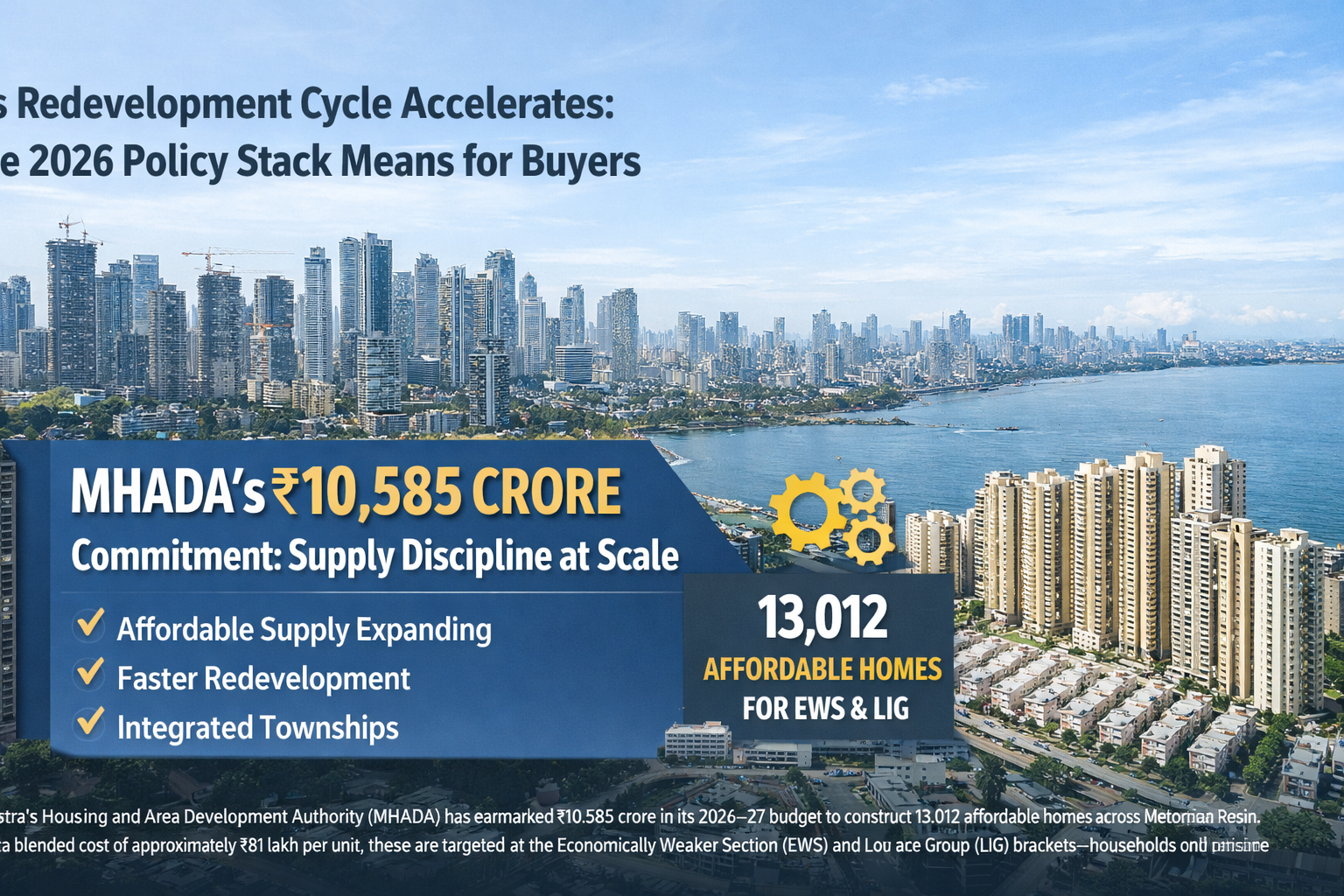
Mumbai's Redevelopment Cycle Accelerates: What the 2026 Policy Stack Means for Buyers
Three distinct policy and capital signals converged in Mumbai's real estate market this week, and together they sketch a clear directional view for the next 24–36 months: affordable supply is expanding, redevelopment is getting faster, and large-format integrated townships are entering the pipeline.
MHADA's ₹10,585 Crore Commitment: Supply Discipline at Scale
Maharashtra's Housing and Area Development Authority (MHADA) has earmarked ₹10,585 crore in its 2026–27 budget to construct 13,012 affordable homes across the Mumbai Metropolitan Region. At a blended cost of approximately ₹81 lakh per unit, these are targeted at the Economically Weaker Section (EWS) and Low Income Group (LIG) brackets—households with annual incomes between ₹3 lakh and ₹9 lakh.
For a mid-income buyer, the direct relevance is secondary market and substitution pricing. Every new MHADA inventory tranche into the Dadar–Dharavi–Worli belt exerts mild downward pressure on resale pricing of older 1 BHK stock in the ₹60 lakh–₹85 lakh range in central Mumbai localities. Buyers sitting on the fence in this segment should watch MHADA lottery timelines; lotteries in the Bandra-Kurla Complex (BKC) and Goregaon catchments have historically oversubscribed 8–12x, signalling unmet demand that bleeds into the private resale market.
BMC's E-TDR Platform: A Structural Accelerant for Redevelopment
The Brihanmumbai Municipal Corporation's new integrated E-TDR (Electronic Transfer of Development Rights) trading platform is operational as of this week. This is a more consequential development than it appears. TDR has historically been Mumbai's primary tool for financing slum rehabilitation and old building redevelopment—developers receive tradeable TDR certificates for surrendering land, which are then sold and utilised elsewhere in the city.
The previous manual, paper-based process introduced opacity, delays of 3–9 months, and significant counterparty risk. The E-TDR platform digitises issuance, transfer, and utilisation, linked directly to BMC's building plan approval system. For the Dadar–Dharavi belt—where Dharavi redevelopment alone involves the relocation of over 65,000 families and a pipeline of 3 crore sq ft of free-sale component—faster TDR processing directly translates to faster project execution and cleaner title transfer timelines for end-buyers.
Investors holding development rights or TDR-bearing plots in the island city (Island City FSI rules, particularly in D and E ward areas) will see a liquidity improvement in their asset as the digital marketplace deepens.
Vingroup's $6.5 Billion Township Signal
Vietnam's Vingroup has signed an MoU with the Maharashtra government to explore a $6.5 billion integrated township investment. The stated model—residential, commercial, retail, and hospitality under one master plan—mirrors Lodha Palava and Hiranandani Gardens in its ambition. While a signed MoU does not guarantee land acquisition or project launch (Maharashtra has a track record of MoUs that take 4–7 years to materialise), this level of FDI interest in Maharashtra's real estate is itself a price-supportive signal for periurban land values on the MMR periphery, particularly in corridors like Khalapur, Alibaug, and Panvel where large contiguous land parcels remain available.
The Bottom Line for Buyers
For a Mumbai HNI investor targeting ₹1.5 crore–₹3 crore: the redevelopment belt from Dadar to Lower Parel remains the highest-conviction medium-term play. E-TDR digitisation reduces execution risk; MHADA supply adds affordable inventory without crowding out mid-premium demand. Projects with RERA Maharashtra registration (maharerait.maharashtra.gov.in) and clear TDR/FSI utilisation certificates are the filter to apply before any commitment.