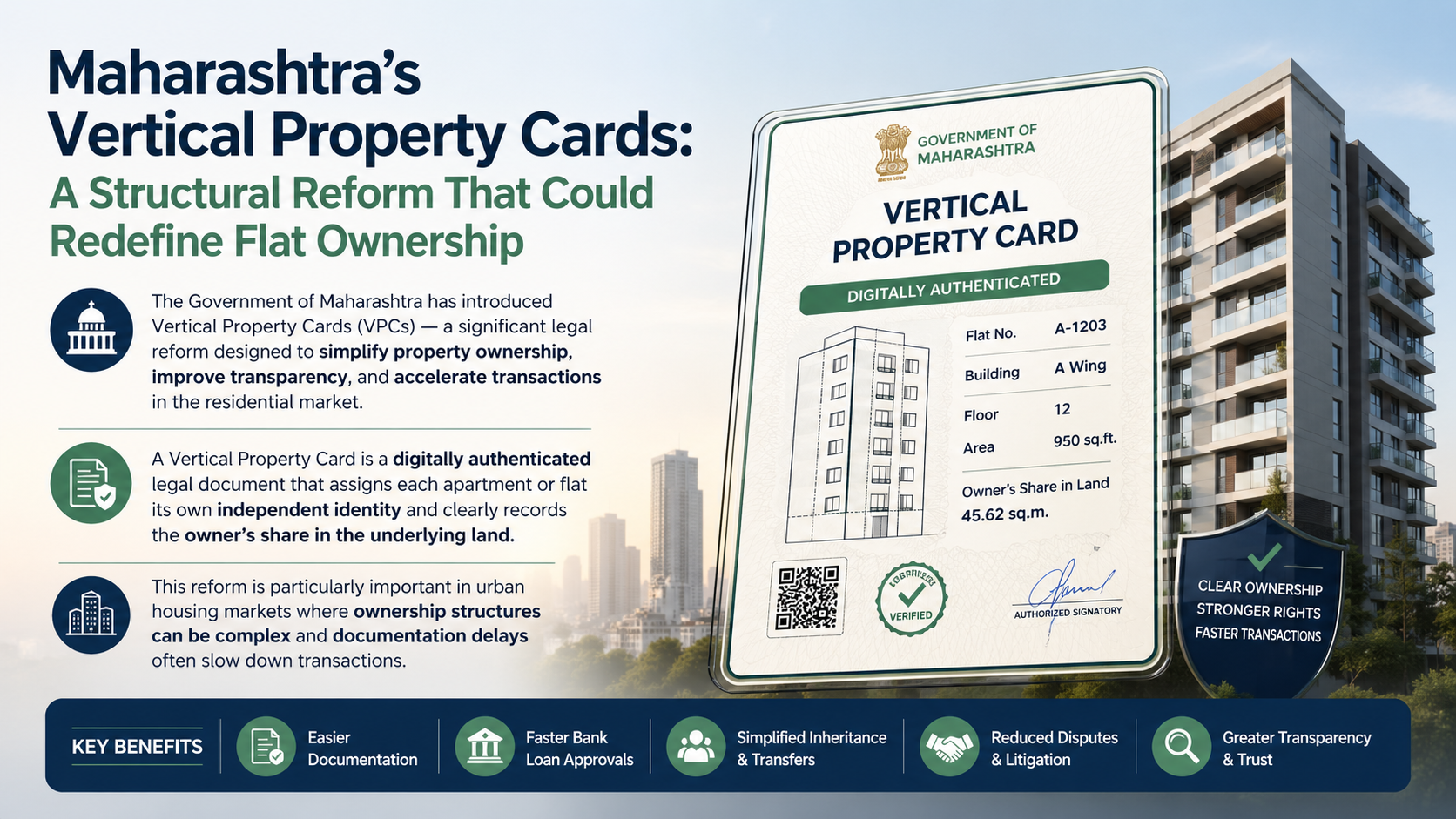
The Government of Maharashtra has introduced Vertical Property Cards (VPCs) — a significant legal reform designed to simplify property ownership, improve transparency, and accelerate transactions in the residential market.
A Vertical Property Card is a digitally authenticated legal document that assigns each apartment or flat its own independent identity and clearly records the owner's share in the underlying land.
This reform is particularly important in urban housing markets where ownership structures can be complex and documentation delays often slow down transactions.
What Problem Is the Government Trying to Solve?
Historically, apartment buyers in many cities have owned a flat but lacked clear documentation of their proportional land rights. This created friction in three key areas:
- Bank loan approvals
- Inheritance and succession transfers
- Resolution of land and ownership disputes
With the introduction of Vertical Property Cards, these processes are expected to become significantly faster and more standardized. The reform is specifically designed to make bank financing easier and reduce the time required to resolve inheritance procedures and disputes.
Why This Reform Matters for the Real Estate Market
Policy reforms that reduce documentation complexity have historically improved market liquidity and buyer confidence. The Vertical Property Card initiative has the potential to deliver similar outcomes.
Key expected impacts include:
- Faster property transactions
- Greater legal clarity for apartment owners
- Improved access to home loans
- Reduced litigation risk
- Higher transparency in ownership records
Most importantly, the reform formally records each flat owner's legal share in land, bringing apartment ownership closer to the clarity traditionally associated with plotted land ownership.
Implications for Buyers, Developers, and Banks
For Home Buyers
- Clearer proof of ownership
- Faster loan processing
- Lower legal uncertainty
For Developers
- Smoother project handovers
- Reduced documentation disputes
- Improved buyer trust
For Banks and Financial Institutions
- Stronger collateral verification
- Faster underwriting decisions
- Lower legal risk exposure
This is why many analysts consider the Vertical Property Card reform a structural governance improvement, not just a procedural change.
The Bigger Picture: A Shift Toward Digitized Property Ownership
India's real estate sector is gradually moving toward digitized, standardized land and ownership records. The Vertical Property Card is part of that broader modernization effort.
Reforms like this typically produce three long-term outcomes:
- Increased transaction speed
- Higher institutional confidence
- More formalization of the housing market
For anyone tracking the Maharashtra residential sector — investors, developers, lenders, or policy observers — this development is a meaningful signal of regulatory evolution.
Bottom Line
The introduction of Vertical Property Cards in Maharashtra is not just an administrative update. It is a foundational reform that could:
- Simplify property ownership documentation
- Accelerate loan approvals
- Reduce disputes and inheritance delays
- Improve transparency across the housing market
In practical terms, this is a reform that makes property transactions easier, safer, and more predictable — which is exactly what mature real estate markets require.