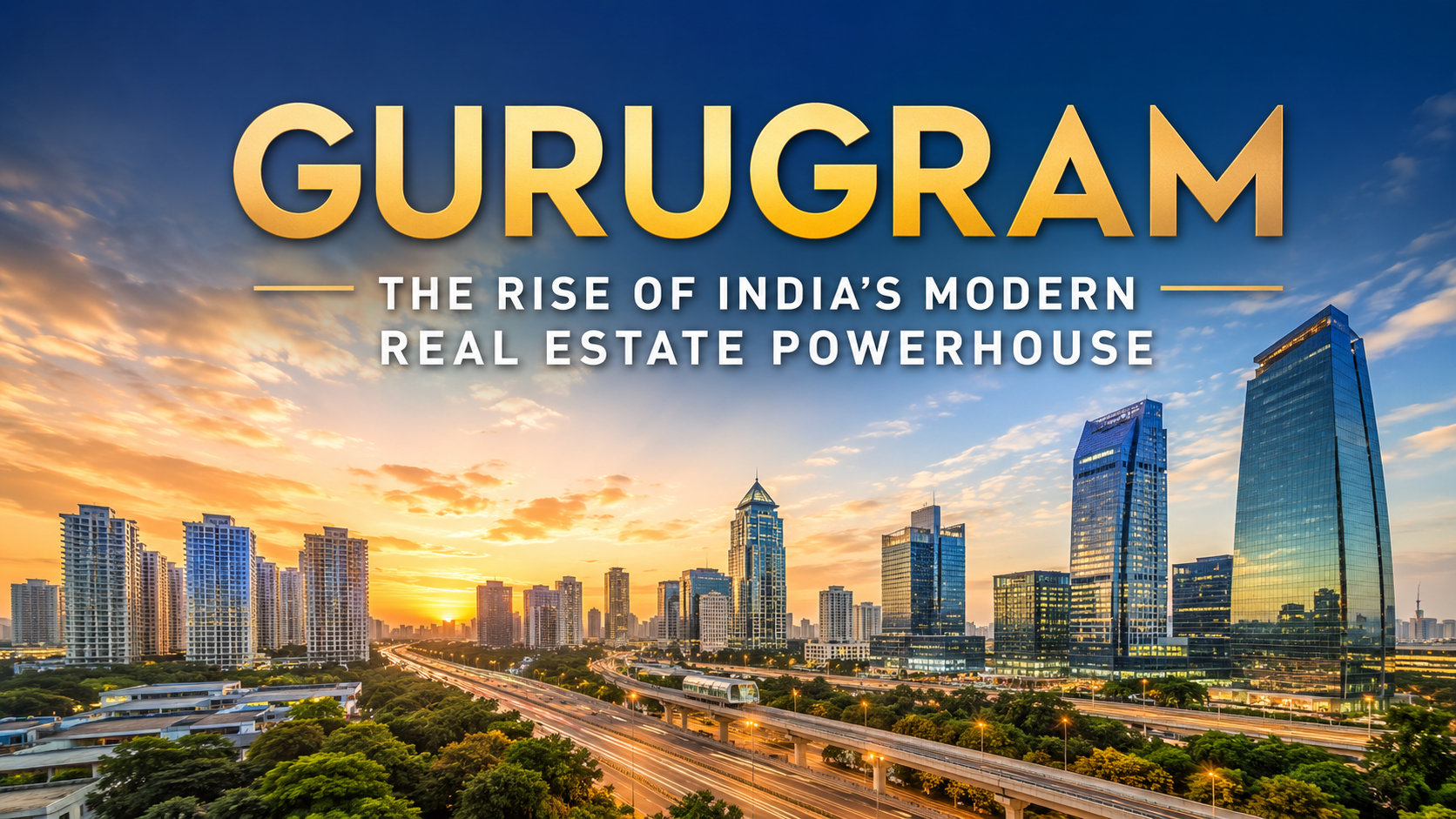
Over the last two decades, Gurugram has undergone one of the most dramatic urban transformations in India. What was once a sparsely populated satellite town on the outskirts of Delhi has evolved into a global business district filled with skyscrapers, multinational corporations, luxury residences, integrated townships, and some of the country's most expensive real estate corridors.
Today, Gurugram is not just a city — it represents a model of India's post-liberalization urban growth story. Its skyline reflects the rise of India's service economy, the expansion of multinational corporations, and the increasing purchasing power of India's upper-middle-class and high-net-worth population.
From Farmland to Financial District
In the early 1990s, Gurugram was largely characterized by agricultural land and low-density settlements. The city's transformation accelerated after economic liberalization, when private developers began acquiring land and developing commercial office spaces for multinational corporations.
The arrival of global companies, IT firms, consulting giants, and financial institutions fundamentally changed the economic profile of the region. Areas such as Cyber City, Golf Course Road, Udyog Vihar, and Sohna Road emerged as major business hubs, attracting thousands of professionals from across India.
This employment-driven expansion created continuous housing demand. Unlike speculative real estate cycles that depend purely on investor sentiment, Gurugram's growth has largely been supported by genuine end-user demand generated by job creation and rising incomes.
Why Gurugram Became a Real Estate Magnet
Several factors contributed to Gurugram becoming one of India's strongest real estate markets.
1. Corporate Expansion
Gurugram became a preferred destination for multinational corporations due to its proximity to Delhi and the international airport. Global companies established large campuses and office spaces, turning the city into one of India's largest white-collar employment centers.
This corporate concentration created strong demand for residential projects across all categories — from affordable housing to ultra-luxury apartments and gated villas.
2. Infrastructure Development
Infrastructure has been one of the biggest drivers of Gurugram's property appreciation. The expansion of Golf Course Road, Southern Peripheral Road, Dwarka Expressway, metro connectivity, and expressway networks significantly improved accessibility across the region.
Improved infrastructure directly impacted land values. Locations once considered peripheral gradually became premium investment corridors as connectivity improved.
The Dwarka Expressway corridor in particular has emerged as one of the most closely watched real estate growth zones in NCR due to its strategic connectivity between Delhi and Gurugram.
3. Rise of Luxury Housing
Over the past decade, Gurugram has established itself as India's leading luxury housing destination. High-income professionals, entrepreneurs, NRIs, and business owners increasingly prefer large-format residences with branded amenities, private clubs, wellness spaces, and integrated lifestyle infrastructure.
Developers responded by launching ultra-premium projects featuring concierge services, smart home technology, golf-facing residences, rooftop amenities, and international-style master planning.
As a result, Gurugram witnessed significant price appreciation in luxury segments, especially along Golf Course Road, Golf Course Extension Road, and sectors surrounding the Dwarka Expressway.
Commercial Real Estate Remains a Major Strength
One of Gurugram's strongest advantages is the balance between residential and commercial development. Unlike many cities where residential growth outpaces economic activity, Gurugram maintains strong office leasing demand.
According to recent reports, Delhi-NCR recorded nearly 15–16 million square feet of office leasing activity in 2025, with Gurugram contributing a significant share.
This commercial momentum strengthens the long-term sustainability of the city's residential market because employment generation continues to support housing demand.
The presence of Fortune 500 companies, co-working operators, startups, fintech firms, and technology businesses creates a diversified economic ecosystem that supports continued real estate absorption.
Investor Confidence Continues to Rise
Investor interest in Gurugram has remained strong because the city continues to offer multiple growth drivers simultaneously:
- Employment growth
- Infrastructure expansion
- Luxury housing demand
- Commercial leasing activity
- Connectivity improvements
- High rental demand
- NRI participation
According to reports, Gurugram RERA registered more than 130 real estate projects in 2025, reflecting continued developer confidence and sustained market activity.
The city has also become attractive for long-term wealth preservation. Many investors increasingly view Gurugram real estate as a strategic asset rather than merely a speculative purchase.
The Challenges Behind Rapid Urbanization
Despite its remarkable success, Gurugram also highlights the challenges of rapid urban growth.
The speed of expansion has often outpaced civic infrastructure planning. Traffic congestion, waterlogging, pressure on drainage systems, uneven road networks, and environmental concerns remain major urban challenges.
Urban experts increasingly argue that Gurugram's next phase of growth must focus on integrated planning, sustainability, mobility management, and public infrastructure rather than only rapid construction.
The city's future success will depend not just on building more towers, but on creating a more livable urban ecosystem.
The Future of Gurugram Real Estate
Looking ahead, Gurugram is expected to remain one of India's most important real estate markets.
Several emerging corridors are projected to drive the next phase of growth, particularly areas connected to Dwarka Expressway, SPR, New Gurugram, and mixed-use business districts.
The city's strategic location, expanding infrastructure, strong corporate base, and premium housing demand continue to provide long-term growth potential.
More importantly, Gurugram has evolved beyond being merely an extension of Delhi. It has established its own economic identity — as a corporate capital, a luxury housing destination, and a symbol of India's urban ambition.
In many ways, Gurugram reflects the story of modern India itself: fast-growing, aspirational, globally connected, ambitious, and continuously evolving.