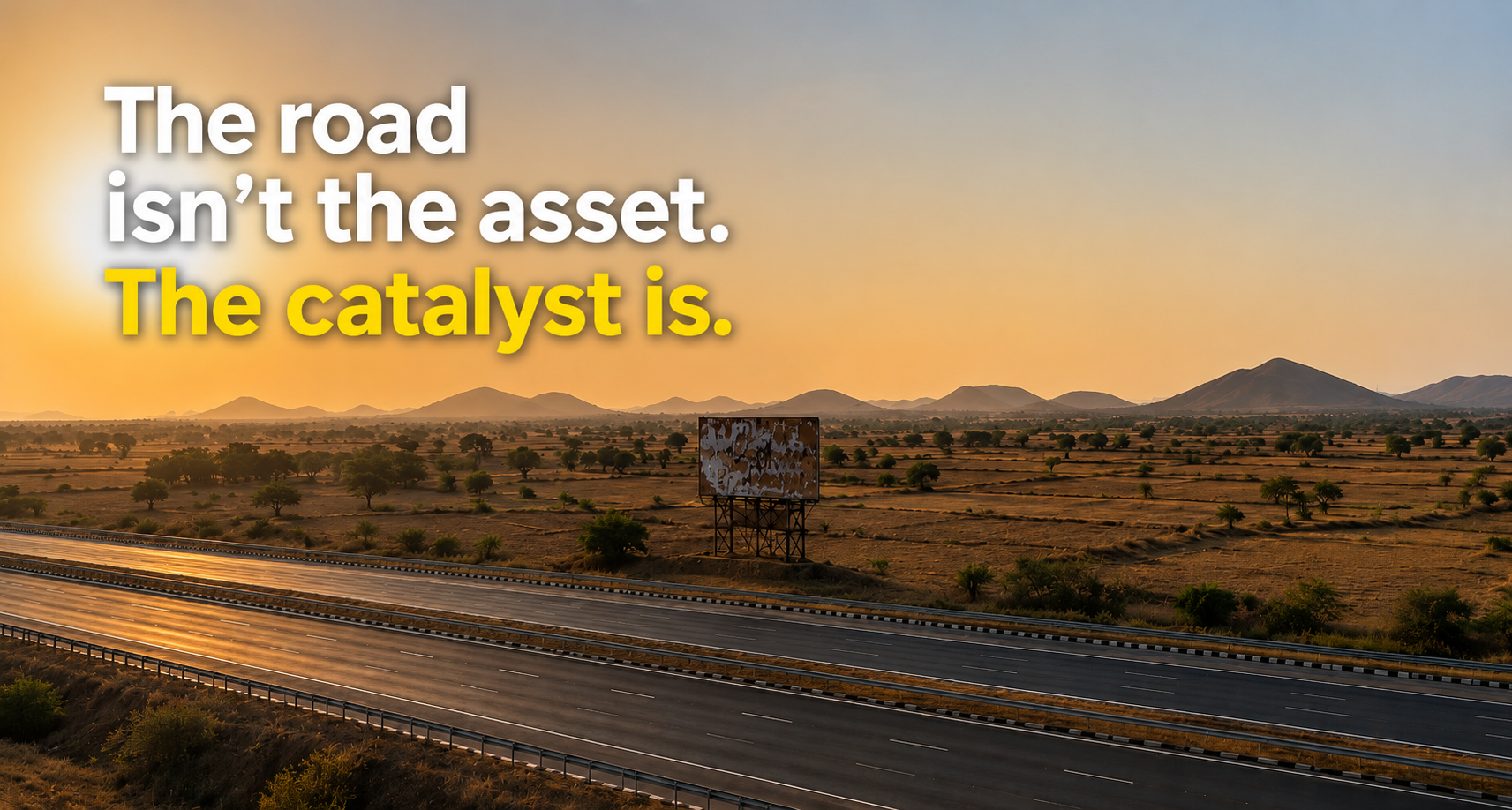
The Delhi–Mumbai Expressway is the largest road project in the country: 1,386 km connecting Delhi to Mumbai through Haryana, Rajasthan, Madhya Pradesh, Gujarat, and Maharashtra. About 929 km is already operational. Full completion is expected in mid-2026.
Tier-II cities along the alignment are reporting genuine activity. CRE Matrix and ANAROCK data show Jaipur residential prices up 12–18% over the last year. Indore is up 10–15%. Land within a 50-km radius of the alignment has appreciated 30–40% in many stretches. Office rentals in Jaipur sit at roughly half of NCR levels, drawing serious corporate interest. Jaipur's Grade A office stock is projected to grow from 7.8 million sq ft in 2025 to 13 million sq ft by 2030.
These are not numbers brokers invented. They reflect a real shift in how capital and corporates are looking at the corridor.
What's missing from the standard coverage is context — specifically, what happened to the last few expressway corridors that got the same coverage in their early years, and what separated the stretches that delivered from the stretches that didn't.
The Yamuna Expressway Lesson
The Yamuna Expressway opened in 2012 between Greater Noida and Agra. The early coverage was almost identical to what you're reading about the DME today: travel time slashed, industrial parks announced, township projects launched, brokers quoting double-digit appreciation, and a wave of organised plot-buying trips for NCR investors.
For most of the next eight years, almost none of it materialised.
Land prices were flat or marginal. Several apartment projects sold in 2013–14 either delayed possession by five to seven years or went into NCLT. Investors who bought speculatively in those years sat on illiquid capital while Golf Course Extension Road and Dwarka Expressway appreciated meaningfully in the same period.
The corridor re-rated only after 2021, when Jewar Airport's progress became visible enough for investors to underwrite. Land prices that took eight years to move 20–30% then moved 200%+ in the next three. According to GeetanjaliHomestate's 2024 report, land along the Yamuna Expressway is up 450% versus 2019, and apartments are up 170%. Almost all of that gain came in the last three years of a twelve-year cycle.
The takeaway isn't that expressways don't work. It's that connectivity is necessary but not sufficient. A six-lane road past your plot does not, on its own, make the plot valuable. What makes it valuable is the demand catalyst the road unlocks — an airport, an IT corridor, an industrial cluster, a port, or organic end-user demand from a city growing for its own reasons. The road is the enabler. The catalyst is the engine.
How This Maps to the DME
The DME passes through cities with strong existing catalysts and stretches with very weak ones. Lumping them together as “DME-adjacent appreciation” is where most investor mistakes start.
The Sohna corridor in Haryana has a catalyst that predates the expressway: proximity to Gurgaon. Sohna is 25 km from Golf Course Extension Road, has been on the radar for over a decade, and the DME interchange has tightened that relationship. End-user demand is real, developer activity is real, and exit liquidity exists. This is the most defensible stretch on the alignment.
Jaipur was a Tier-II services, tourism, and education hub before the expressway. The road has accelerated what was already happening — GCC interest, IT and ITeS expansion, hospitality investment. The 12–18% residential appreciation is anchored to genuine corporate occupier demand, not speculative plot flipping. Office rents at half of NCR levels are a structural advantage that doesn't disappear with one cycle.
Vadodara sits within the Gujarat industrial belt with Dholera SIR, the Sanand auto cluster, and Ahmedabad-Vadodara metropolitan integration as catalysts. The DME makes a strong industrial corridor stronger. Industrial and Grade A logistics real estate here is the most defensible play on the entire alignment.
Indore has organic catalysts — services, education, and a manufacturing ecosystem in Pithampur. The DME accelerates these rather than creating them. Ratlam is more dependent on industrial development that hasn't fully materialised yet and should be treated as an earlier-stage bet, not a comparable to Jaipur or Vadodara.
Dausa, Bhandarej, and the Aravalli stretch are where the standard “30–40% land appreciation within 50 km” headline does the most damage. The road passes through. There is no current industrial cluster, no airport, no IT corridor, and no anchoring city of scale. The appreciation here is largely on agricultural land being sold at non-agricultural prices, often without clear titles, with no clear pathway to development. This is the stretch most likely to look like Yamuna Expressway circa 2014–19 for a long time.
The Filter That Matters
Before treating “Delhi–Mumbai Expressway adjacent” as an investment thesis, four questions are worth answering honestly.
First, is there a demand catalyst within 30 km of the plot, or is the expressway the entire story? If it's the latter, you're betting on speculation flowing in, not on real economic activity. Sometimes that bet pays off — usually only in cycles you can't time.
Second, is the plot within 5–10 km of an operational interchange? Land 30 km off the alignment with a “planned connecting road” is not expressway-adjacent. It is agricultural land being sold at expressway prices.
Third, is the title clean and the layout development-authority approved, or is it gata-number agricultural land waiting on conversion? A meaningful share of the appreciation being marketed is in unapproved plots where exit depends on finding the next speculator. Approved RIICO, GIDC, or comparable development-authority plots are a different asset class with different risk-return.
Fourth, is the holding horizon honest? Infrastructure-led re-ratings happen in step-changes, not smooth annual increments. Five to ten years is a realistic underwriting horizon. Eighteen months is a marketing pitch.
For Whom the DME Actually Makes Sense
For commercial and industrial occupiers — logistics, warehousing, light manufacturing — the operational stretches of the DME meaningfully reduce the cost of doing business in Tier-II locations. The investment case for industrial and Grade A logistics real estate near interchanges is the strongest part of the corridor story and the part most under-marketed to retail investors, who tend to be pushed toward residential plots instead.
For end-user residential buyers in Jaipur, Vadodara, Indore, or Sohna, the appreciation case is supported by genuine economic catalysts and is reasonable to underwrite over a five to seven year horizon.
For speculative plot investors looking at raw agricultural land in unanchored stretches with the expectation of 30–40% per year appreciation, the lesson from Yamuna is instructive. The road alone is not enough. Most of these plots will sit flat for years before any meaningful re-rating, if one arrives at all.
The DME will create real wealth. The wealth will accrue narrowly — to investors who bought near genuine catalysts, with clean titles, and held long enough for the step-change to arrive.
The rest of the activity is just movement.
— REMAX Westside Realty