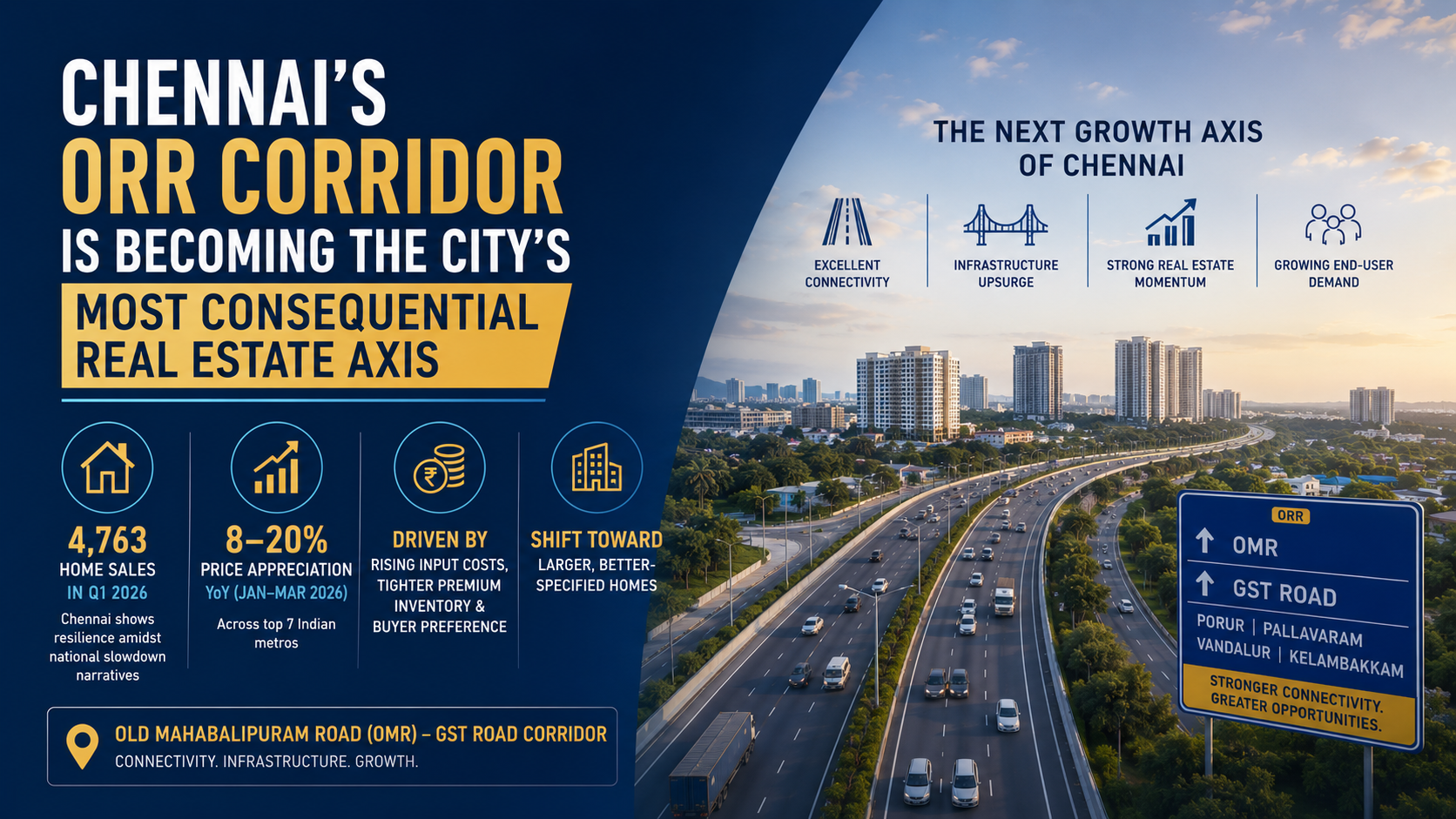
Chennai's ORR Corridor Is Becoming the City's Most Consequential Real Estate Axis
Chennai's residential market posted a resilient Q1 2026, registering 4,763 home sales even as national narratives around a slowdown circulated — a performance that outpaced several peers among India's top seven cities. According to JLL India data (April 30, 2026), apartment prices across major metros appreciated 8–20% year-on-year in January–March 2026, driven by rising input costs, tighter premium inventory, and a structural shift in buyer preferences toward larger, better-specified homes. Chennai's market remained on the right side of that range.
Beneath the headline figures, the Outer Ring Road (ORR) corridor — a 62-km stretch linking Minjur in the north to Vandalur in the south — is fast emerging as the defining axis of Chennai's next growth phase. JLL's India Head of Research and City Lead (Chennai), Jerry Kingsley, described it as "the city's next major economic and real estate growth axis", while Anarock's City Head Sanjay Chugh noted the corridor enables "a more distributed, polycentric model by unlocking land for planned urbanisation".
Why the ORR Is Structurally Different from OMR or GST Road
Unlike Old Mahabalipuram Road (OMR), which grew almost entirely on IT-sector tailwinds, or GST Road, which is transit-led, the ORR is being shaped by Chennai Metropolitan Development Authority (CMDA) policy as a mixed-use, integrated township corridor. According to Casagrand's Deputy Managing Director C.G. Sathish, development along the ORR "has evolved from being primarily industrial and logistics-focused to a more balanced, mixed-use ecosystem", with improving social infrastructure now keeping pace with residential launches.
This policy-led approach matters to a buyer underwriting a 10–15 year horizon. Speculative demand is lower; end-user and long-horizon investor demand is rising — a healthier mix that supports price stability.
GCC Momentum as a Leading Indicator
Chennai's GCC story continues to deepen. Healthtech firm Illumia — a Roper Technologies business unit — opened a new office at International Tech Park Chennai in April 2026, adding cloud engineering, information security, and product engineering roles. The firm's CEO cited Chennai's "exceptional technical talent" as core to its next growth phase. GCC headcount expansion is a leading indicator for residential demand across the ₹60 lakh–₹1.5 crore band, as mid-to-senior tech employees form the dominant homebuyer cohort in corridors adjacent to employment nodes.
Who Should Be Watching the ORR Right Now?
For the IT professional (28–38, budget ₹60L–₹1.2Cr): Projects in Vandalur–Kelambakkam and Perungalathur nodes along the southern ORR arc offer competitive per-sqft pricing compared to saturated OMR micro-markets, with better FSI utilisation and township-grade amenities increasingly available.
For the HNI investor (40–55, budget ₹1.5Cr–₹3Cr): The corridor's industrial-to-mixed-use transition historically compresses the window for pre-launch acquisition at base pricing. With CMDA-guided urbanisation and improving social infrastructure, the ORR is past the pure speculation stage — a lower-risk entry than a purely emerging zone.
Bottom Line
Chennai's Q1 2026 momentum — strong sales volumes, 8–20% price appreciation per JLL, and mid-to-premium segment leadership — is not a one-quarter anomaly. The ORR's structural evolution from logistics belt to planned urban corridor, layered on steady GCC-driven employment growth, builds a credible medium-term demand case for buyers willing to underwrite a 5–7 year hold. The window before infrastructure discounts fully narrow is measurable in months, not years.